
You May Also Like:
- What is F Grade Plywood? A Guide to F14 and F17 Formwork Plywood
- What is the Difference Between F14 and F17 Formwork Plywood?
- F14 Plywood: Key Considerations for Selecting the Right Grade for Your Project
Choosing between F14 grade plywood and F17 grade plywood is a common on-site debate because it affects performance, safety, finish quality, and cost on real slabs, decks, and wall pours. The simplest truth is that F17 grade plywood is stronger and stiffer on paper, but outcomes still depend on span, support layout, handling, and the total formwork system.
What Do F14 Plywood and F17 Plywood Strength Ratings Actually Mean?
They are Australian stress grades that indicate the plywood’s structural capacity, mainly bending strength and stiffness used for structural selection. In formwork terms, F14 plywood and F17 grade plywood help crews predict how a sheet will resist bending and control deflection under wet concrete pressure.
Many suppliers also offer High-Density Overlay (HDO) plywood as a concrete-finish upgrade. HDO plywood improves surface smoothness and wear resistance, and it can extend reuse cycles, but it does not automatically change whether the core is F14 grade plywood or F17 grade plywood.
Reinforced concrete depends on more than formply. Reo bars are critical in Australian construction, and formwork quality helps maintain correct cover and alignment so the steel performs as designed.
Consistency matters too. Buying quality formwork plywood for large projects often comes down to reliable grading; the lamination process affects strength/durability, and supply repeatability. Covert Procurement’s role in improving formwork plywood quality and reducing costs is a useful example of why procurement and specification control can matter as much as the grade stamp.
How Much Stronger Is F17 Plywood Compared to F14 Grade Plywood?
F17 grade plywood is higher-rated than F14 grade plywood, so it is typically chosen where higher loads or tighter deflection control are expected. Practically, crews use F17 grade plywood when they want more resistance to bending under wet concrete pressure and better stiffness for line and level.
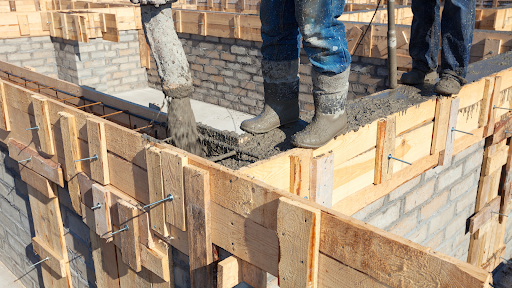
On site, “stronger” often shows up as reduced deflection, fewer finish defects from panel bowing, and improved edge stability, depending on build quality and veneer consistency. Common issues with formwork plywood during concrete pouring still occur with both F14 grade plywood and F17 grade plywood if sheets are over-spanned, poorly supported, or waterlogged.
Reuse of formwork plywood is also a deciding factor. Higher-rated F17 grade plywood can hold alignment across more cycles, but only if it is treated well and the overlay stays intact.
Formwork plywood maintenance for durability on site protects both F14 grade plywood and F17 grade plywood:
- Edge sealing to stop water ingress and ply separation
- Correct storage off the ground and out of weather
- Proper release agents to reduce sticking and tear-out
- Cleaning after stripping to preserve the face and overlay
For curved concrete forms in modern architecture, the grade matters, but consistency can matter more. Formwork plywood/curved concrete forms in modern architecture often prioritise uniform veneers and overlay quality, especially when HDO plywood is specified for a premium face.
Does F17 Grade Plywood Have a Higher Span Rating Than F14 Grade Plywood?
Span is the spacing of bearers or joists beneath the sheet, and panel stiffness affects deflection and finish quality. With comparable thickness and support conditions, F17 grade plywood generally supports longer spans or heavier wet-concrete loads than F14 grade plywood.
Span decisions should never be made in isolation. Many crews pair sheeting selection with LVL formwork to tighten the system. A guide to LVL formwork sizes in Australia and choosing the right LVL beam for project needs are typical selection checks, alongside proper LVL formwork installation for maximum strength in vertical and horizontal applications.
Teams often refer staff to an ultimate guide to formwork plywood for durable construction to standardise set-outs, fixing, sealing, and reuse expectations.
Safety sits alongside span. The importance of scaffold netting for worker safety becomes more pronounced on elevated deck pours where access and edge protection overlap with formwork installation.
When Is F14 Plywood Sufficient Instead of Using F17 Grade Plywood?
F14 grade plywood is often sufficient when loads are moderate, spans are tighter, and the priority is cost control without compromising compliance. On many jobs, F14 grade plywood performs well when there are frequent supports, sensible pour rates, and good installation.
Typical use cases include smaller residential slabs, short spans, lower pour heights, and sites where panels are treated as semi-disposable due to damage risk. In those environments, F17 grade plywood can be over-specification if the support layout already controls deflection.
Concrete strength is still heavily driven by steel. Proper rebar installation for maximum concrete strength relies on accurate formwork so cover and placement are not compromised. Many projects also weigh rebar selection and durability, including comparing rebar types for project suitability, understanding rebar types/uses in building projects, and the importance of rebar in reinforced concrete structures. For harsh environments, rust-resistant rebar extends coastal infrastructure lifespan and reduces lifecycle risk.
Formwork choices also sit beside site protection. Chain & shade mesh for worker/material protection in construction can reduce dust spread and improve control, and chain & shade mesh for noise reduction on urban sites is common near neighbours. Teams choose chain & shade mesh 50% and 90% coverage options, specify UV-resistant chain & shade mesh options for long-term outdoor use, and follow chain shade mesh installation for long-lasting performance.
Is F17 Grade Plywood Worth the Extra Cost for Structural Applications?
Yes, F17 grade plywood is often worth it when deflection or failure risk is expensive through rework, delays, finish defects, or safety exposure. It tends to suit high walls and columns, faster pours, heavier slabs, wider bearer spacing, higher reuse targets, and premium finishes where HDO plywood is paired with a stronger core.
Cost comparisons should account for how suppliers label products. Formwork plywood vs formply varies by merchant, so they should confirm the sheet is truly structural, correctly graded, and suitable for repeated use, whether it is F14 grade plywood or F17 grade plywood.
Total system cost matters too. LVL formwork improves strength/reduces construction costs by straightness and efficiency, and environmental benefits of using LVL formwork in construction include reuse and reduced waste, which can offset higher sheeting costs. With the impact of increased building material costs on the Australian construction industry, standardising on the right grade can also stabilise procurement and reduce variations.As a rule of thumb, they should use F14 grade plywood where spans are conservative and replacement is expected, and step up to F17 plywood where spans, loads, reuse, or finish quality increase. They should lock in correct materials, careful workmanship, and accurate steel placement, then act now by standardising their specification and sourcing to reduce defects on the next pour.